Week 1
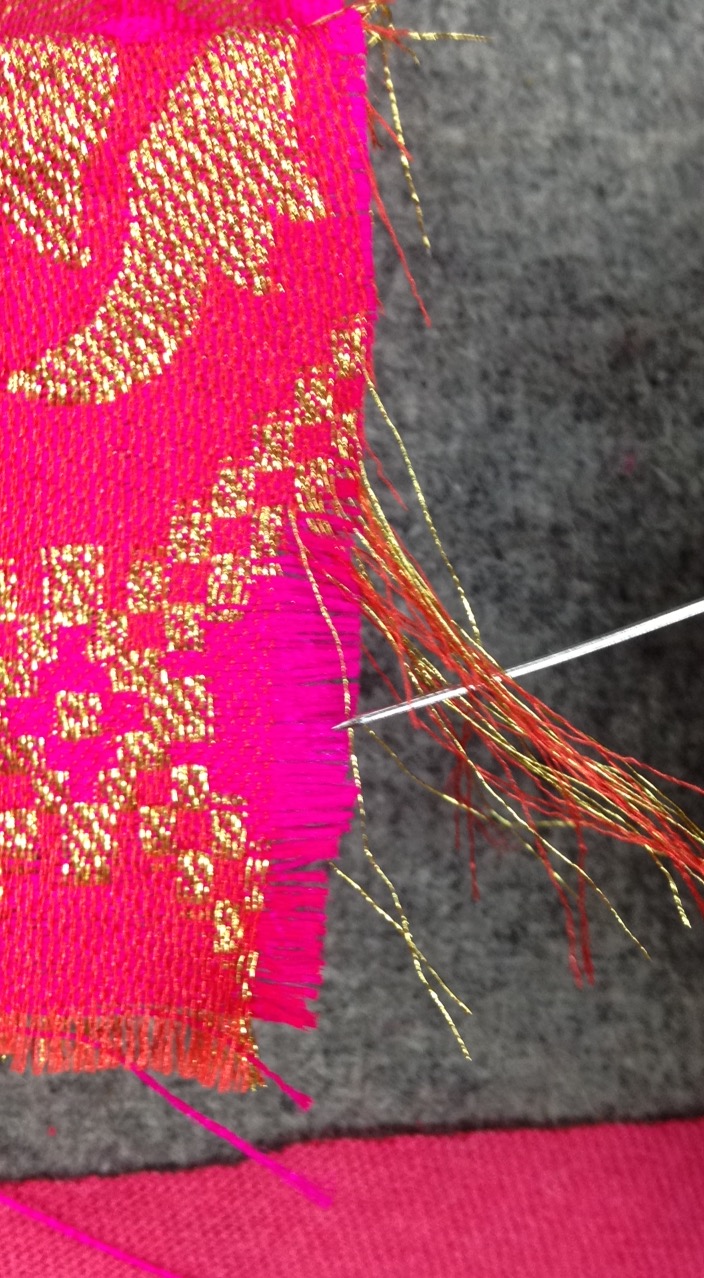
The study of swatches was to understand the basic structure and pattern of woven and knitted fabrics. We acquire 2 swatches: 1 from a Nike lounge wear top and 1 from a silk dupatta.
Woven fabrics are made by using two or more sets of yarn interlaced at right angles to each other. On the other hand, Knitted fabric is a textile that results from knitting. Its properties are distinct from woven fabric in that it is more flexible.
WOVEN FABRIC-
Characteristics of swatch 1:
1. Fibres seen at right angles.
2. Gold, pink and orange thread seen.
3. Gold thread creating a rich look.
4. Strong and stiff swatch.


In textile industry, woven fabrics are made by using two sets of yarn by interlacing among them. One set of yarn is known as warp yarn another one is weft yarn. The total process of producing woven fabric is known as weaving. Woven fabric may produce from hand loom or power loom. This technique produces a wide variety of products. Shirt, trouser, denim and jeans are the example of woven fabric.
Woven fabrics have a longer life because of their structure. They can be easily cut into different shapes and are excellent for producing artistic fall of garments. However the raw edges ravel or fray easily and need to be protected. Fabrics having more fibre count keep the shape well. Low count fabrics are less durable and tend to displace soon. It is easy to sew on and feed through a sewing machine. This technique makes the fabric look good with pleats and sharp corners.
KNITTED FABRIC-
Characteristics of swatch:
1. Fibres seen looped into chain stitch.
2. Single color thread used.
3. Highly stretchable.
4. Blended fabric with elasticity.


In weaving, threads are always straight, running parallel either lengthwise or crosswise. By contrast, the yarn in knitted fabrics follows a meandering path, forming symmetric loops symmetrically above and below the mean path of the yarn. These loops can be easily stretched in different directions giving knit fabrics much more elasticity than woven fabrics.
Depending on the yarn and knitting pattern, knitted garments can stretch as much as 500%. For this reason, knitting is believed to have been developed for garments that must be elastic or stretch in response to the wearer’s motions, such as socks and hosiery. For comparison, woven garments stretch mainly along one or other of a related pair of directions that lie roughly diagonally between the warp and the weft, while contracting in the other direction of the pair and are not very elastic, unless they are woven from stretchable material such as spandex.
Leave a Reply